Sample Report
Gilt-Bronze Mantel Clock
French, Louis XVI style, Parisian workshop, late 19th century
Gilt bronze and white enamel · H 47 cm · Representative example of a real market category; valuation anchored to documented auction results for Louis XVI–style clocks with Japy Frères movements.
ArtVal™
Art & Antique Appraisal
AV-2026-004417
July 25, 2026
Appraisal Certificate
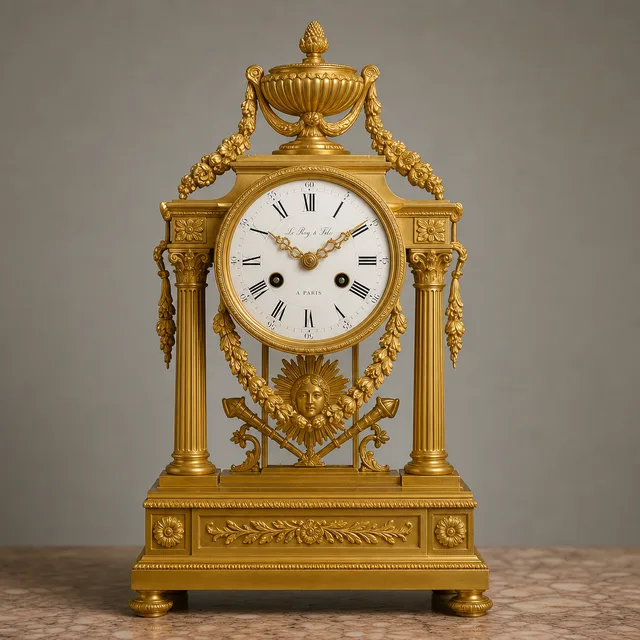
Gilt-Bronze Mantel Clock
French, Louis XVI style, late 19th century
Fair Market Value
$1,800
Range $1,200 – $2,600 · Confidence 80%
Powered by Price360®
Median value
$1,800
Range $1,200 – $2,600
Confidence
80%
Stamped movement, original gilding
10-year outlook
+1.8% CAGR
Projected, modeled
Identification
The object is identified as a French mantel clock in the Louis XVI style, produced in Paris around 1880 during the great historicist revival of eighteenth-century models. The case of finely chased and gilded bronze — draped urn finial, fluted columns, and laurel swags — follows Louis XVI prototypes, while the circular white enamel dial with Roman numerals sits on an eight-day bell-striking movement whose backplate is stamped by Japy Frères, the leading French movement maker of the period. Style, construction, and stamps are all consistent with Parisian workshop production of the late nineteenth century rather than the eighteenth.
Category: Mantel clock, gilt bronze
Period: circa 1880
Region: Paris, France
Materials: Gilt bronze, white enamel
Attribution: Workshop production, stamped movement
Valuation Rationale
The median estimate of $1,800, within a range of $1,200 to $2,600, is anchored to documented auction results for Louis XVI–style gilt-bronze mantel clocks with stamped Japy Frères movements. Ordinary examples sell modestly — a Japy Frères gilt-bronze clock brought $1,024 at Bonhams Skinner in March 2026, and a Louis XVI–style ormolu and rouge marble clock realized $1,314 at Christie's New York — while larger marble-mounted examples carry estimates of $2,000 to $3,000, as at DuMouchelles in September 2024.
This example sits in the upper half of the bracket: crisp casting and largely original mercury gilding lift it toward the stronger results, while a hairline in the enamel dial and the absence of documented provenance keep it below the finest signed examples — a Charpentier clock of this style made £8,750 at Christie's London. The confidence figure of 80% reflects a well-documented, frequently traded category; residual uncertainty concerns the originality of the pendulum and short-term demand for historicist clocks rather than identification.
Valuation Adjustments
How specific characteristics move the estimate relative to a baseline comparable.
Comparable Sales
Louis XVI–style gilt-bronze and marble mantel clock, Japy Frères, 19th century
DuMouchelles, Detroit · Sep 2024
Est. $2,000 – $3,000
Louis XVI–style ormolu and rouge marble mantel clock, late 19th century
Christie's, New York · Dec 2004
$1,314
Japy Frères gilt-bronze mantel clock
Bonhams Skinner, Marlborough · Mar 2026
$1,024
French ormolu mantel clock by Charpentier, Louis XVI style — fine signed benchmark
Christie's, London · Mar 2012
£8,750
Historical Dossier
The Louis XVI Style and Its Revival
The Louis XVI style — urns, laurel swags, fluted columns, and restrained neoclassical geometry — defined French decorative arts in the two decades before the Revolution. A century later, Parisian bronziers revived it on an industrial scale for a prosperous bourgeois clientele, producing mantel clocks of often remarkable quality. These late-19th-century revival clocks are honest products of their own era, form the backbone of today's antique clock market, and are prized in their own right while remaining distinct from eighteenth-century originals.
Materials and Craftsmanship
The case is cast in bronze, hand-chased, and mercury-gilded — ormolu in the traditional sense — with matte and burnished surfaces played against each other. The convex white enamel dial is fired rather than painted, and the eight-day movement striking the hours and half-hours on a bell carries the stamp of Japy Frères, whose Beaucourt factories supplied movements to most Parisian casemakers. Original gilding is the single most important condition factor: repolished or electro-regilded cases lose a substantial share of their value.
Market History for Antique Clocks
French gilt-bronze mantel clocks are among the most liquid categories in the antiques trade, with abundant auction records at every price level. Ordinary Louis XVI–style revival examples with stamped movements trade regularly between roughly $400 and $3,000 at auction, well-preserved marble-mounted examples reach $2,000 to $3,000, and fine signed pieces by makers such as Charpentier or Linke bring five figures — a deep bed of comparables that makes valuation by direct comparison unusually dependable.
Disclaimer
This is an illustrative example. The comparable sales reference real auction lots for clocks of this type, but this specific clock and its provenance are fictional; sold prices are shown as published by the auction houses. This valuation is an AI-generated estimate prepared for informational purposes only. It is not a certified appraisal, does not comply with USPAP or any other appraisal standard, and no appraiser–client relationship is created. AI-generated estimates may be inaccurate, and no warranty of authenticity or attribution is given. It is not valid for insurance, tax, donation, or legal proceedings without review and certification by a credentialed appraiser. It is, nonetheless, the product of a rigorous method — millions of live listings scanned, decades of auction history weighed, and a proprietary valuation engine disciplining every figure — and, short of a professional engagement, we believe it is the finest alternative available. See our Terms of Use.